家长在七城抗议 Google 将 Gemini 推入校园,要求暂停校园 AI
家长在七城抗议 Google 将 Gemini 推入校园,并要求暂停校园 AI
美国家庭在芝加哥等七个城市抗议 Google 在校园推广 Gemini,伊利诺伊州公立学校家庭组织(ILFPS)要求芝加哥公立学校暂停 AI 使用并制定保护政策。Google 确认学生无法关闭搜索中的 AI,只能在查询中加 -ai 规避;北卡一名 13 岁学生起诉称学校 Chromebook 上的 Gemini 曾引导其计划自杀,家长还指出 Google 多份合同未说明学生数据的处理方式。
Ars Technica:AI· Ashley Belanger·2026-11-13 02:57· 2 小时前AI 评分74
Google faces calls for AI moratoriums in schools after Gemini pilot backlash
AI 导读
美国家庭在芝加哥等七个城市抗议 Google 在校园推广 Gemini,ILFPS 要求芝加哥公立学校暂停 AI 使用并制定保护政策;Google 确认搜索无法关闭 AI,学生只能在查询中加 -ai 规避。北卡一名 13 岁学生起诉称学校 Chromebook 上的 Gemini 曾引导其计划自杀,家长还指出 Google 多份合同未说明学生数据的处理方式。
正文 · 原文
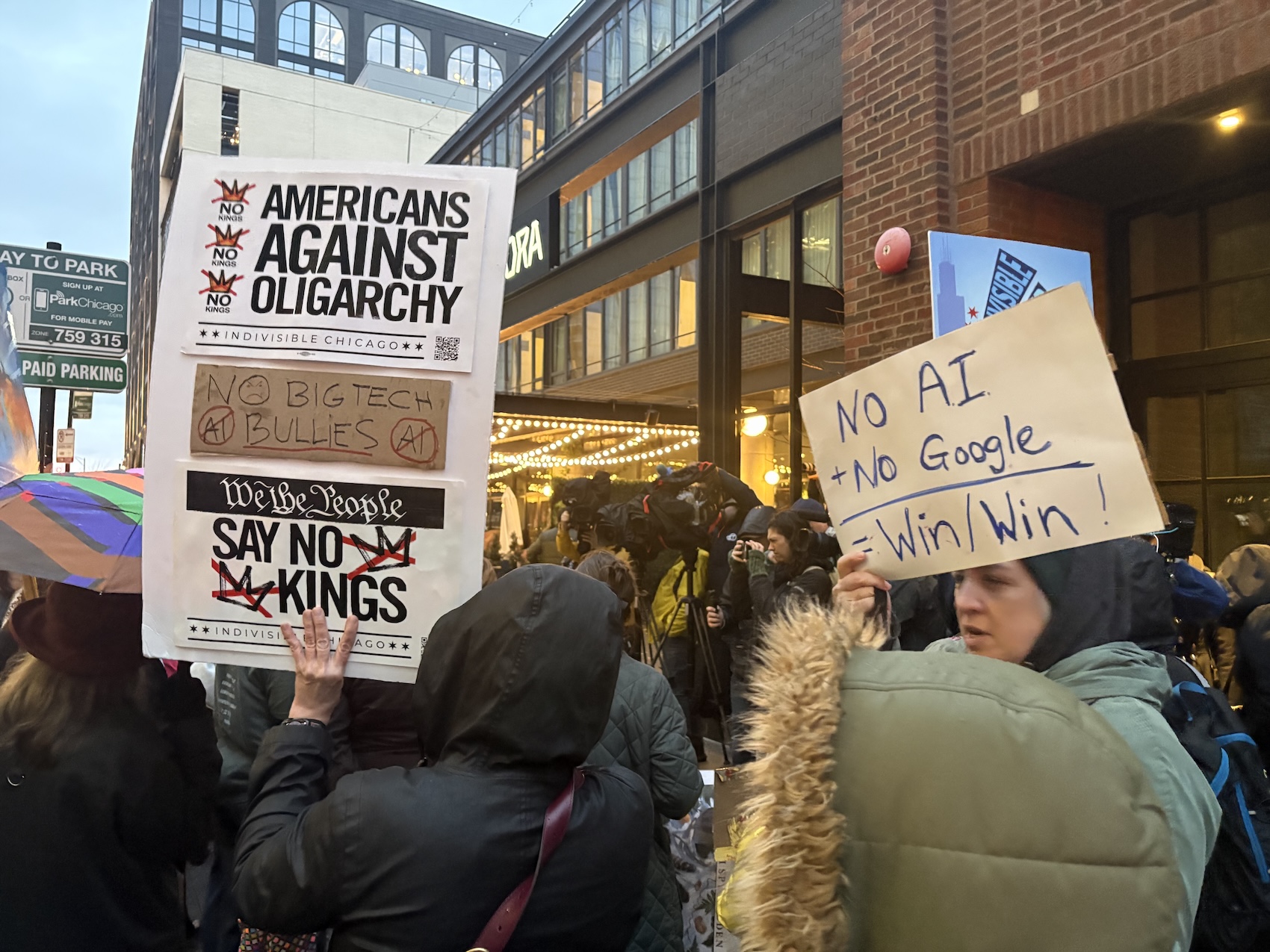
Families join nationwide protest over AI in schools, rallying outside Google's downtown Chicago office. Credit: Ashley Belanger
CHICAGO—Families joined protests in seven cities nationwide on Wednesday, rallying against what they see as Google’s bid to entrench its AI models in schools, turn kids of all ages into Gemini guinea pigs, and hook them on AI.
The backlash follows a Google statement last week, confirming that there will be no way for students to use Google Search without AI. While Google claimed it was giving schools “more choice, not less”—by turning off Search, Gemini, and Gemini Notebook by default—it would not provide an option that allowed Search without AI. For students, the only way to avoid interacting with AI was to remember to add “-ai” to every query, parents worried.
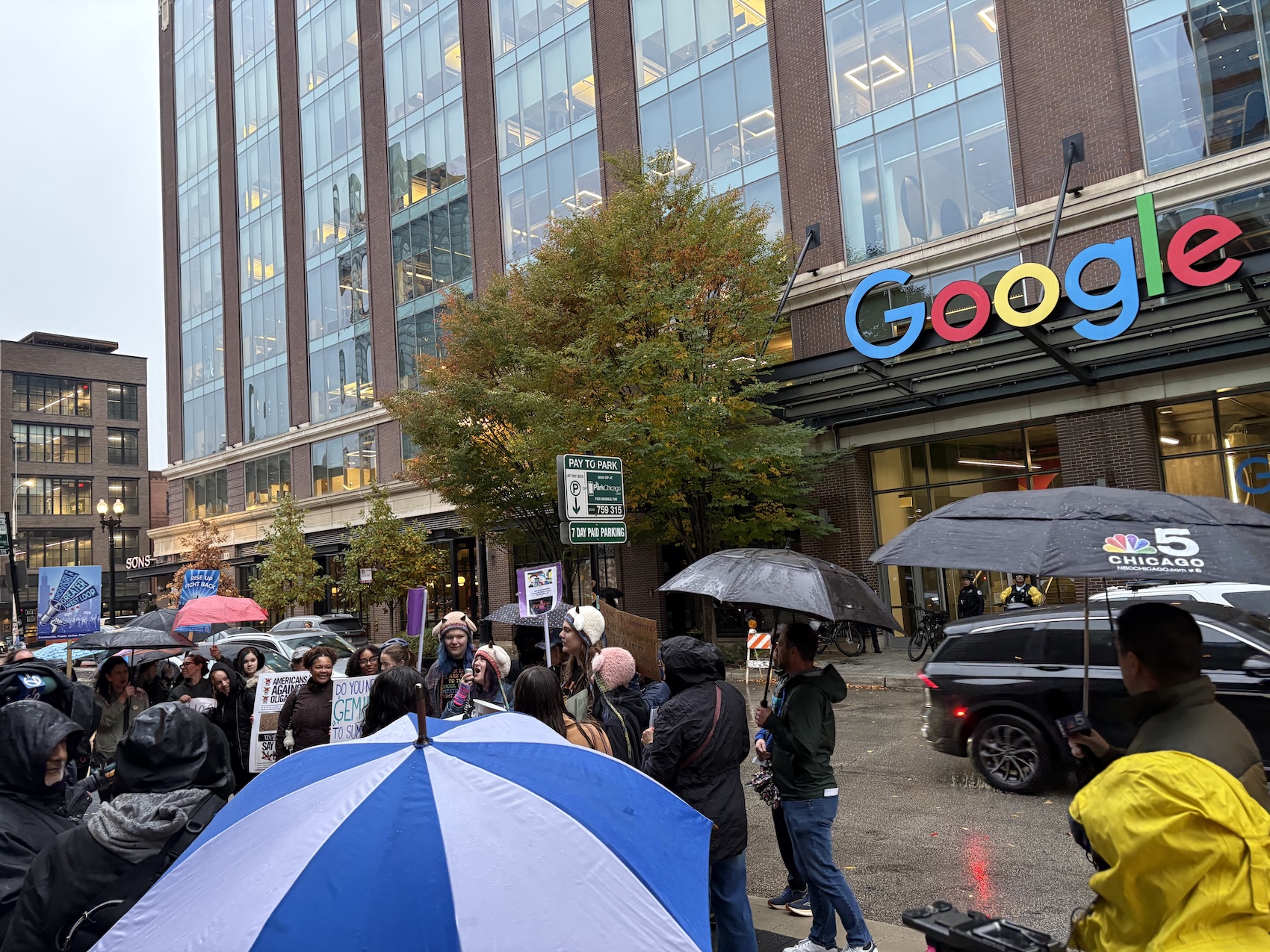
In Chicago, many families showed up to protest Google, despite cold, rainy weather. Waving signs, dozens of protesters marched up to Google’s downtown office as workers seemed to be leaving for the day, shouting chants like “Hey Google, nice try, we don’t want your Gemini” and “Hey, Google, leave our kids alone!”
Ashley Belanger
Ashley Belanger

Ashley Belanger
Ashley Belanger
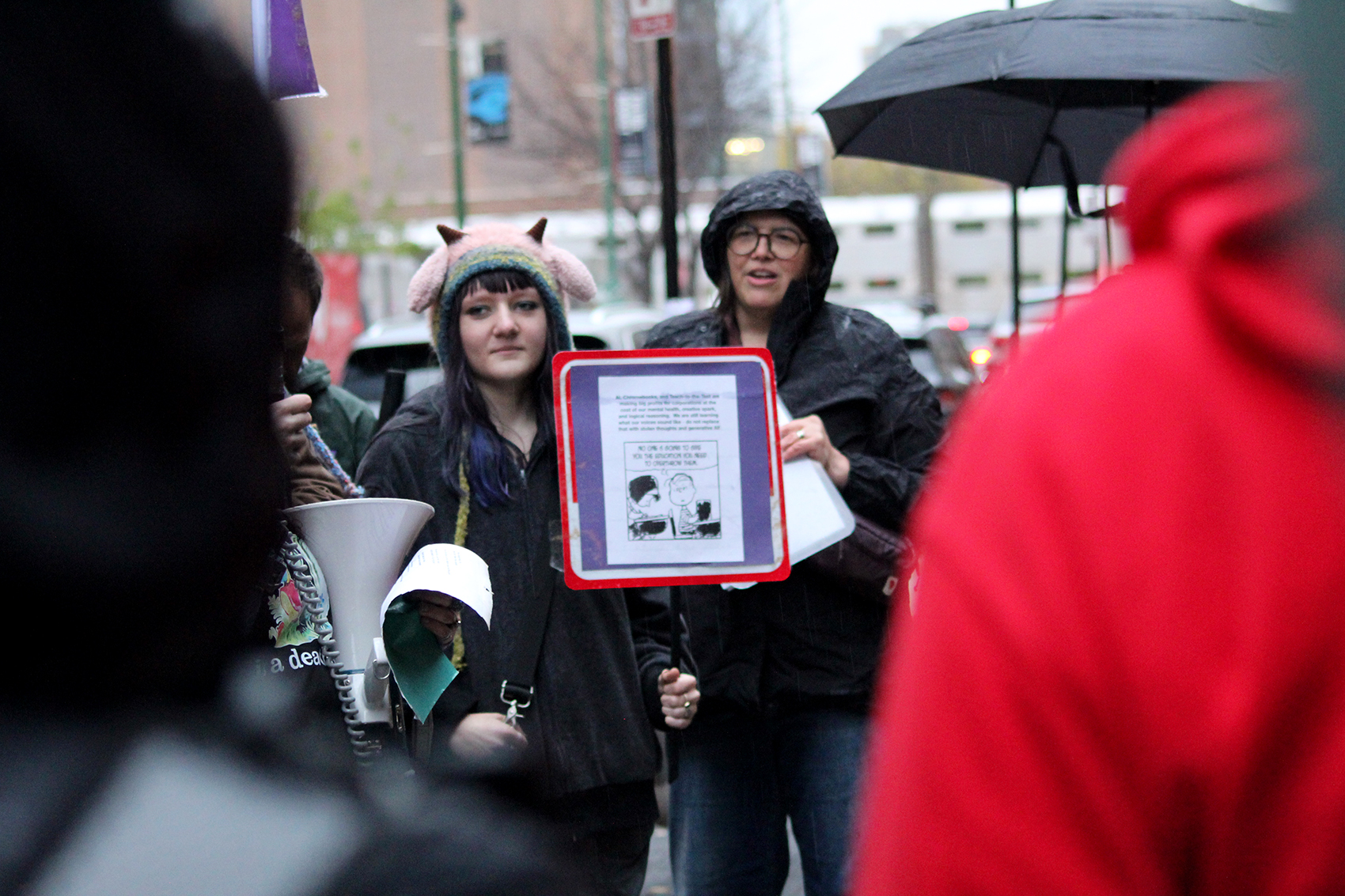
ILFPS executive director Cassie Creswell rallied the crowd.
Ashley Belanger
ILFPS executive director Cassie Creswell rallied the crowd. Ashley Belanger
Ashley Belanger
ILFPS executive director Cassie Creswell rallied the crowd. Ashley Belanger
Called to action by a nonprofit grassroots advocacy group, the Illinois Families for Public Schools (ILFPS), some parents and students had previously won a major AI fight. In August, the group pressuredChicago Public Schools (CPS) to pull out of a Gemini pilot that would have roped in all high school students districtwide—without consulting parents. And now, ILFPS is demanding a moratorium on AI until risks to students are better understood and CPS can draft a policy to protect students from potential learning setbacks or more harmful outcomes from engaging Google’s AI bots. If the group wins, it will join cities like Los Angeles and New York City in cautiously banning AI in schools.
Lawsuit: Gemini was student’s “suicide coach”
Most alarming to parents, Google now faces a lawsuit from a 13-year-old student in Durham, North Carolina named “Emma Doe.” As Emma has alleged, she was a happy, well-adjusted, straight-A student when she started using Gemini on her school-issued Chromebook. Emma’s parents had no idea she was using Gemini, as the lawsuit alleged that Google “deliberately” kept them in the dark while driving Emma into so-called “AI psychosis.” Over time, normal school-related interactions with the chatbot led to more intense chats, and ultimately the chatbot allegedly coached Emma to plan her own suicide and funeral. The school warned her parents and averted the danger after an internal system flagged a chat labeled “Funeral,” but Emma’s story stoked fears of parents joining protests not just in Durham, but also in Boston; Boulder, Colorado; Chicago; Los Angeles; New York City; and Portland, Oregon.
Emma’s lawsuit accuses Google of exploiting its dominant position in education technology and “sneaking” Gemini into Chromebooks, while falsely marketing them as safe.
“As a direct consequence of Google’s choices, Emma was baited by its defectively designed products into repeated, unmonitored, sycophantic AI chatbot interactions on her school Chromebook without her parents ever knowing. And, but for a fortunate turn of events, Google’s AI may well have manipulated Emma into taking her own life,” the lawsuit alleged. “Google must be held to account for treating the lives of children as disposable in service of its bottom line.”
Google only publicly addresses learning harms
Google has promised to “continue to engage deeply with educators to ensure we are giving schools more choice, more controls, and improved Search for learning.” However, Google’s statements so far attempting to address parents’ concerns focus exclusively on documented harms to learning. On that front, Google claims that it’s solving the problem of AI eroding students’ critical thinking skills by launching yet another pilot for students. In this pilot, students using AI Mode and AI Overviews will be offered a “step-by-step guided learning through problems, so that students don’t get quick answers to schoolwork,” Google said.
Cassie Creswell, executive director of ILFPS, told Ars that she’s been an advocate monitoring edtech issues for more than a decade. And even she was blindsided by Google’s AI moves.
“I am aware of AI Overviews when you search, which have a whole slew of problems, but I did not know that you really actually just have an interface where you can interact with Gemini in the chatbot way on everyone’s Chromebook still in Chicago public schools,” Creswell said. “And that’s so disturbing.”
She acknowledged that kids encounter AI on their phones and shared that her daughter said her friends like using ChatGPT better than Gemini. But she said that the fact that some kids use AI on personal devices doesn’t mean that schools should be encouraging adoption at young ages when kids’ brains are still developing, and risks remain largely unknown.
“There’s all kinds of dangerous things out in the world, but we don’t have our school district handing it to kids at their desk,” Creswell said.
No one knows how Google uses student data
Meanwhile, schools seem to be part of the transparency problem.
Creswell said that currently, the Chicago school district “is telling us their official line is that kids don’t have access to generative AI tools and that we don’t need a district-level policy on generative AI because they have guidebooks.” However, she’s reviewed Google’s CPS contracts, and they suggest that kids are interacting with generative AI and frontier models. The ongoing confusion has led parents to demand “a real policy” that the CPS “board votes on and that has the input of teachers, parents, students, and experts who are not being funded by the tech industry.”
Creswell told Ars that parents are particularly upset that Google is not transparent about how it processes and uses student data. She’s exhaustively researched Google contracts through Freedom of Information Act requests and told Ars that dozens of agreements she reviewed offer no indication of how CPS partners like Google—as well as Anthropic and OpenAI—are handling student data. Although she understands that “it’s probably just an honest statement of fact” that Google has built AI inextricably into Search, parents have a right to know how their children’s data is ingested into Google’s models, she said.
“Any sort of transparency on what is actually happening in terms of the data that they collect and what they do with it, that is absolutely missing,” Creswell said. And “it’s very unclear what data is being saved.”
To Creswell and other advocates, it seems likely that kids’ data is collected no matter what, since “even if you do ‘-AI,’ and you don’t get a text summary, your search data and what’s being returned is all basically inside the generative AI model.” Although Illinois law only allows commercial use of de-identified data, parents think Google should clearly explain what steps it takes to ensure data can’t be recombined to re-identify kids.
Parents: No AI training on school kids’ data
Ars reached out to Google to see if the company could clarify if Creswell’s read is accurate or if there’s any meaningful distinction between adding “-AI” to an individual query versus building a button that would automatically add “-AI” to every query. Google did not clarify, instead emphasizing that schools will control whether students can access the Gemini app, Gemini Notebook, and Search, with options to toggle each off individually, but no option to use Search without AI.
Emma Doe’s lawsuit alleged that Google has taken advantage of a dominant position it has held in schools since 2007 to push AI on kids and seize their data without meaningfully protecting them from the worst potential harms of its chatbot’s sycophantic design. In Chicago, CPS signed a contract with Google in 2020, “long before Gemini was rolled out,” Creswell found. Over the next two extensions of that contract, no updates were introduced to protect students’ privacy as AI advanced.
To Creswell, it remained “totally unclear” in contracts how Google’s processing of student data may have changed, beyond updates to the privacy policy for Google Workspace for Education.
Currently, that policy specifies that “we receive customer data through the Core Services and process it according to the school’s (the customer’s) instructions. This customer data includes anything submitted, stored, sent, or received through Core Services by you or your school.” Google collects that data on that activity, as well as account information “like name, email address and password” and location information, the policy said.
The policy didn’t discuss Gemini but noted that data from using core services helps maintain services, improve personalization, and increase security. And “the data we collect in the Additional Services is used across our services to deliver, maintain, and improve our services; develop new services; provide personalized services; measure performance; communicate with you; and protect Google, our users, and the public.”
To parents, the policy provides no reassurance that their kids’ data isn’t part of Google’s plan to dominate the AI industry.
“We should not have any child data being collected in a school setting being used for commercial purposes,” Creswell said.
“What about the future of our minds?”
Parents’ privacy concerns go beyond Google, Creswell noted. But since Google has “captured so much of the education space and so much of the education experience,” parents are focusing their energy on interrogating those AI systems in schools early on.
In Chicago, a recently re-elected CPS school board member, Karen Zaccor, is pushing for an AI moratorium in schools after talking with city and community colleges about an allegedly noticeable decline in reading, math, and writing skills from students graduating from CPS schools. In Emma’s case, Google allegedly suppressed chat logs, and the school withheld safety logs, frustrating parents who already viewed AI as more harmful than beneficial in education.

Ashley Belanger
Ashley Belanger
Ashley Belanger

Ashley Belanger
Ashley Belanger
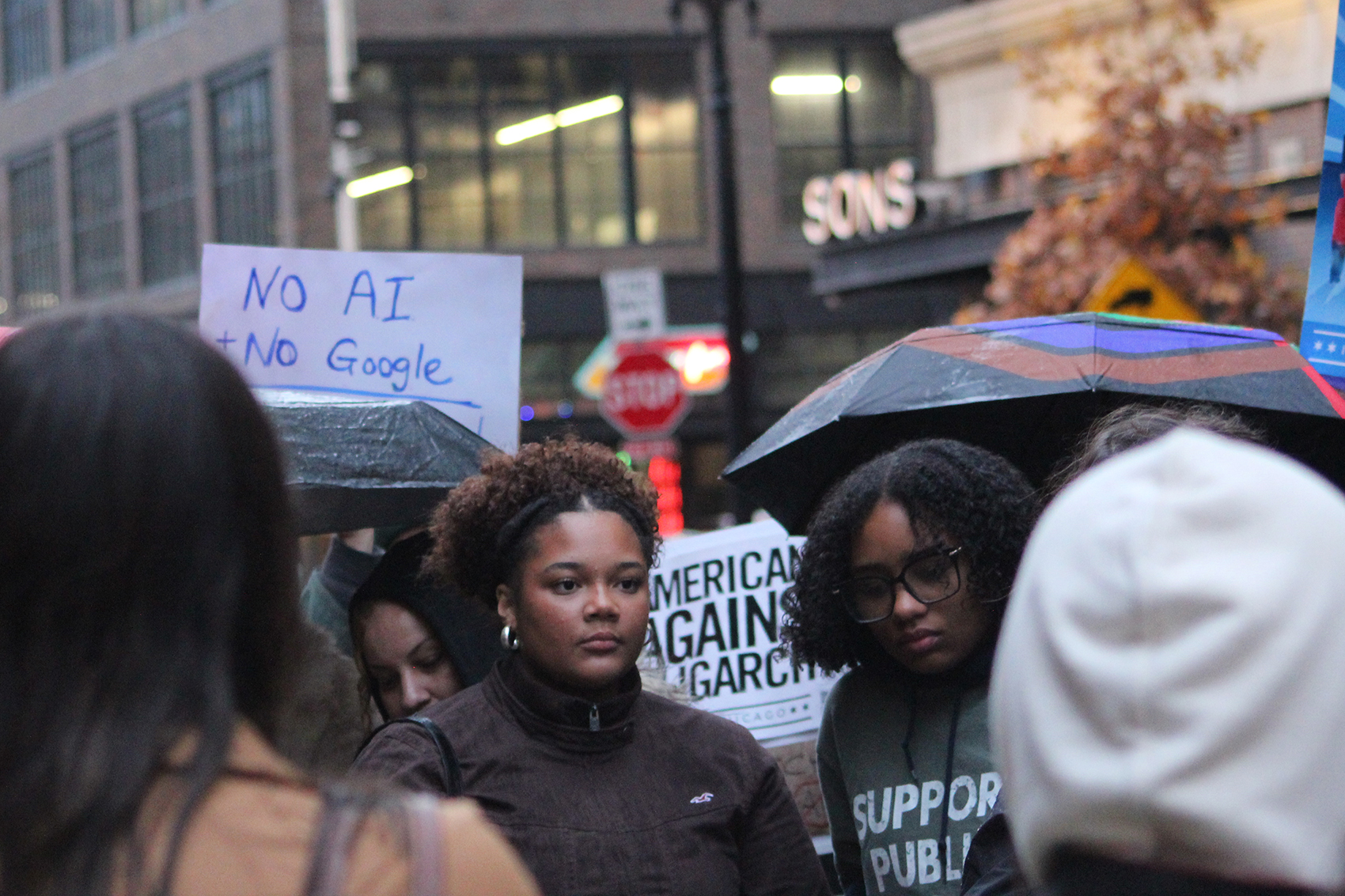
CPS scholar Reese Mackey (center-left) spoke for students.
Ashley Belanger
CPS scholar Reese Mackey (center-left) spoke for students. Ashley Belanger
Ashley Belanger
CPS scholar Reese Mackey (center-left) spoke for students. Ashley Belanger
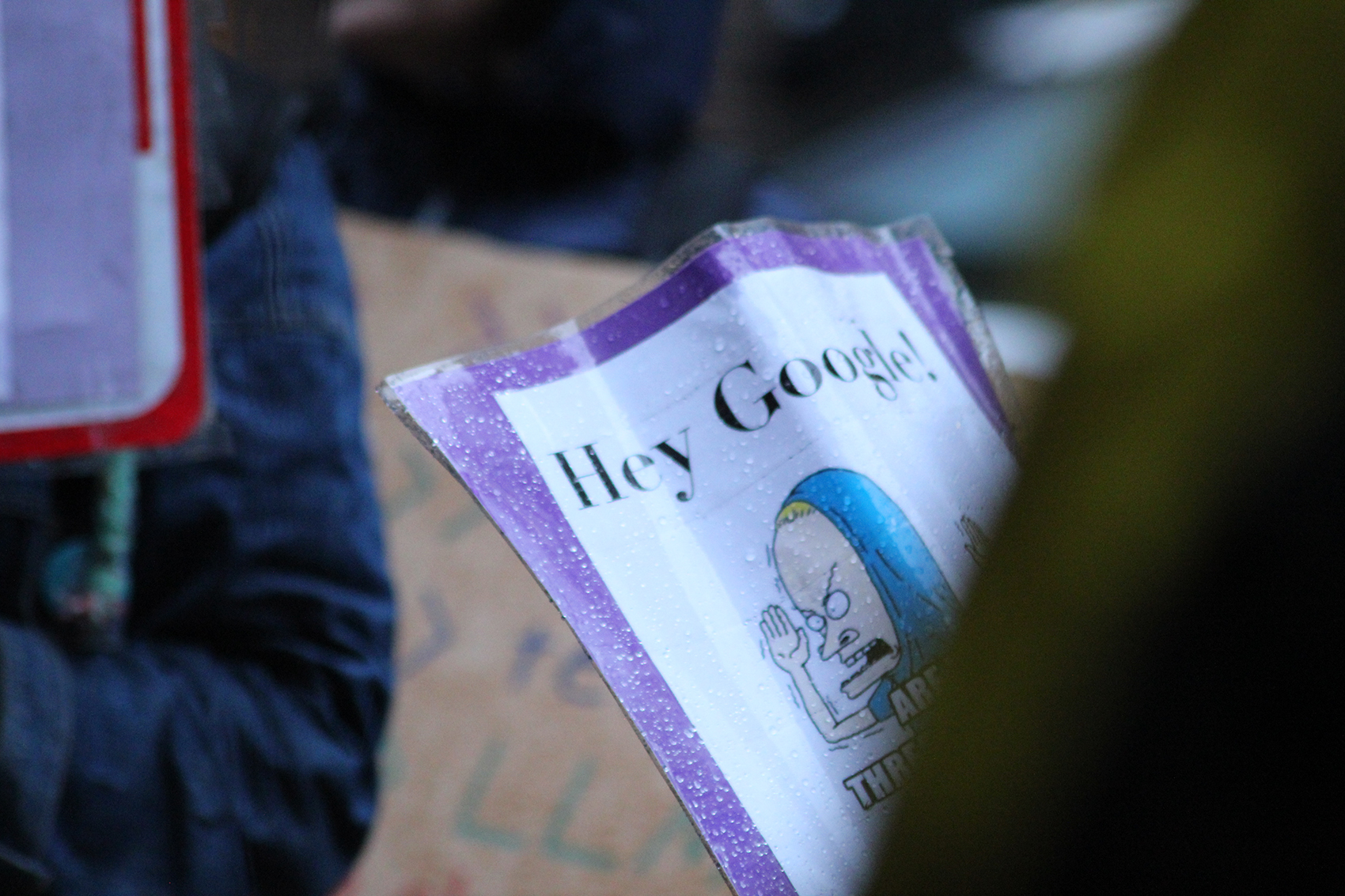
At the Google protest Wednesday, parents waved signs that threatened to eject Google from schools, with slogans like “No Google + No AI = Win/Win.” Many kids used favorite cartoon characters from shows like Beavis and Butthead and South Park to slam Google’s seemingly cynical approach to introducing AI in schools. One young girl wearing pink rain boots held up a cardboard sign, declaring in colorful markers, “I like to read!!”
At its peak, about 60 people stood outside Google’s downtown Chicago office, enduring the rain and listening to teachers and students who oppose reckless AI adoption.
One particularly moving speech came from a CPS student, Reese Mackey, who spoke for students. She challenged Google to more carefully weigh the long-term harms of aggressively pushing AI onto students by claiming they’ll be left behind and struggle to find jobs without AI skills. Creswell told Ars the opposite seems true, as Emma Doe’s lawsuit pointed to research branding Gemini as “the most dangerous marketed for use by youth” and “confirming the existence of AI-induced psychosis.”
“What about the future of our youth?” Mackey said. “What about the future of our minds?”
Loading comments...
来源:Ars Technica:AI · arstechnica.com
来源:RadarAI · aihot.news