Azeem Azhar:科学研究的瓶颈不是智能,AI 自我改进仍限于外围环节
Azeem Azhar 在 Exponential View 专栏中指出,AI 科研加速的瓶颈不在智能,而在研究闭环能否覆盖整个流程。
Azeem Azhar:Exponential View· Azeem Azhar·2026-10-26 23:25· 12 分钟前AI 评分59
📈 Monday data: For science the bottleneck isn’t intelligence
AI 导读
Azeem Azhar 在 Exponential View 专栏中分析 AI 科研加速的真实边界,认为瓶颈不在智能而在研究闭环能否覆盖整个流程。
正文 · 原文
In the AI Investment Brief today: CapEx updates and lease commitment breakdowns
Anthropic co-founder Jack Clark recently said in a speech at the IMF that the singularity has begun:
For many years, researchers and science fiction authors have forecast a future in which AI systems drastically increase the pace of overall scientific and technical progress, making things move so quickly that it is hard for humans to keep up.
They call this the singularity. I believe that this year we have gained convincing evidence that it has now begun.
This follows Anthropic’s claim that in August, 26% of its AI R&D was led by Claude, with a human supervising its work. In October, OpenAI posted 719 math manuscripts1 made by its internal model. Math and coding are two fields where a research loop can close without leaving the desk. But can the loop close in the rest of science?
The loop is real
The idea is not new. Mathematician Irving John Good, who had worked with Alan Turing at Bletchley Park, argued that a machine smarter than us “could design even better machines; there would then unquestionably be an ‘intelligence explosion,’ and the intelligence of man would be left far behind.”
The Gödel machine, a self-improving computer that can rewrite its own code better than its prior, was first proposed in 2003. In 2025, researchers at Sakana AI and the University of British Columbia set out to show that this was possible. Their agents iteratively improved their own code through a feedback loop, resulting in gains of 30 pp on SWE-bench and more than 15 pp on Polyglot, testing coding skills beyond Python.
The idea has since been tested in other labs. A Gemini-powered agent called AlphaEvolve found a faster matrix multiplication kernel used for training Gemini, speeding up the kernel by 23% and cutting Gemini’s training time by 1%. In China, MiniMax reported that its M2.7 model worked on improving its own agent’s harness, skills, sampling and memory. Over 100 rounds of rewriting led to a 30% gain, per its internal evaluations.
In each case, what was being rewritten was not the model itself but everything around it.
Is it better than human work?
In September this year, in what seemed like a milestone, an AI-built agent proved as good at improving other AI agents as a human-built one. It did that in what appeared to be half the steps. But the result was inconclusive: the differences between runs were greater than the difference between the AI- and human-built agent results.
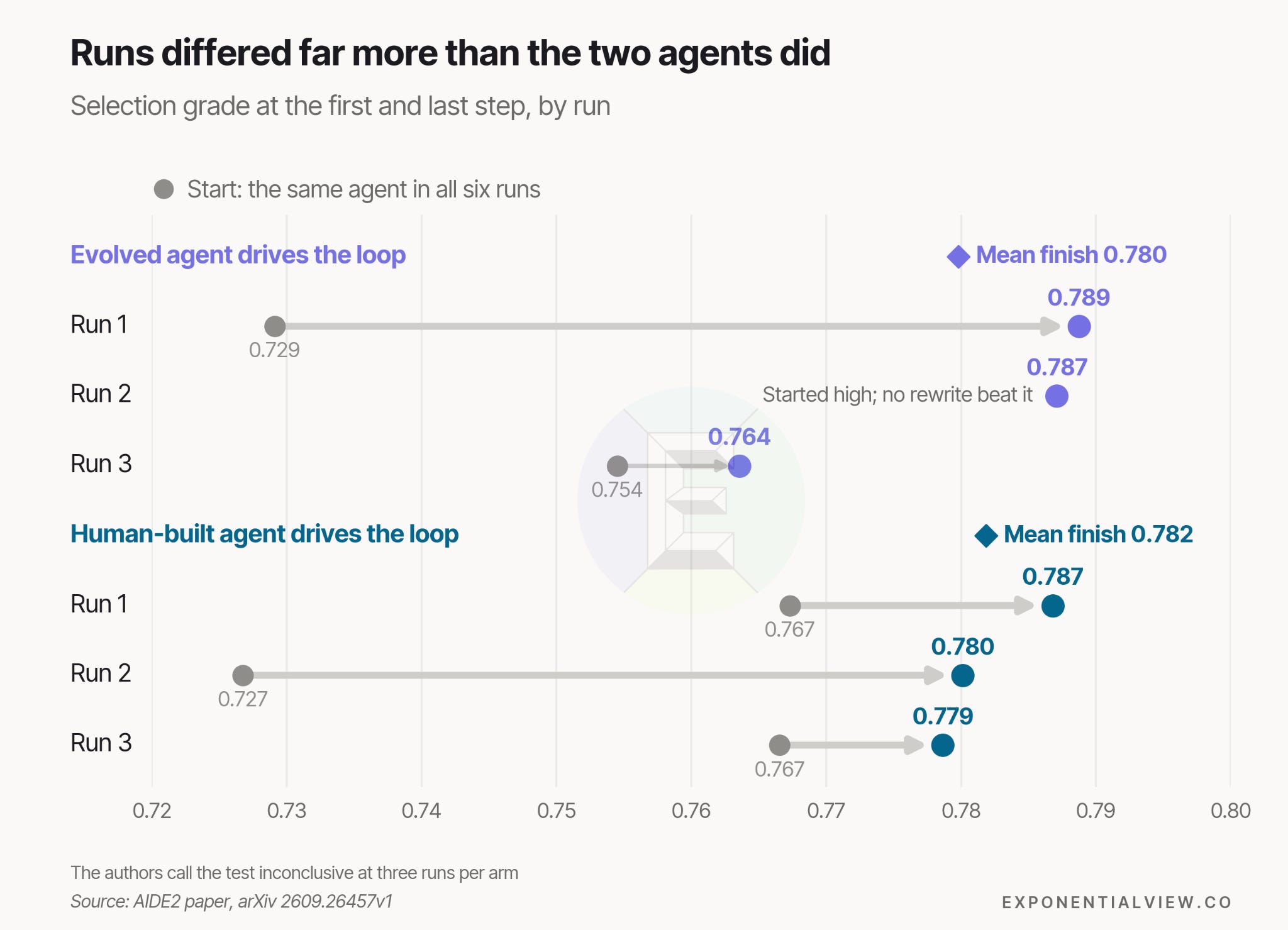
Nonetheless, this is increasing the chatter around recursive self-improvement (RSI) in AI. Google’s Sundar Pichai said that “you have RSI loops along with AI researchers in various aspects of model development.” Sakana AI published a paper on RSI through multi-agent collaboration, finding that after two cycles its system scored 1.2–1.6x better per output token than the base model across four research benchmarks.
challenges that view. He splits AI self-improvement into five overlapping types.
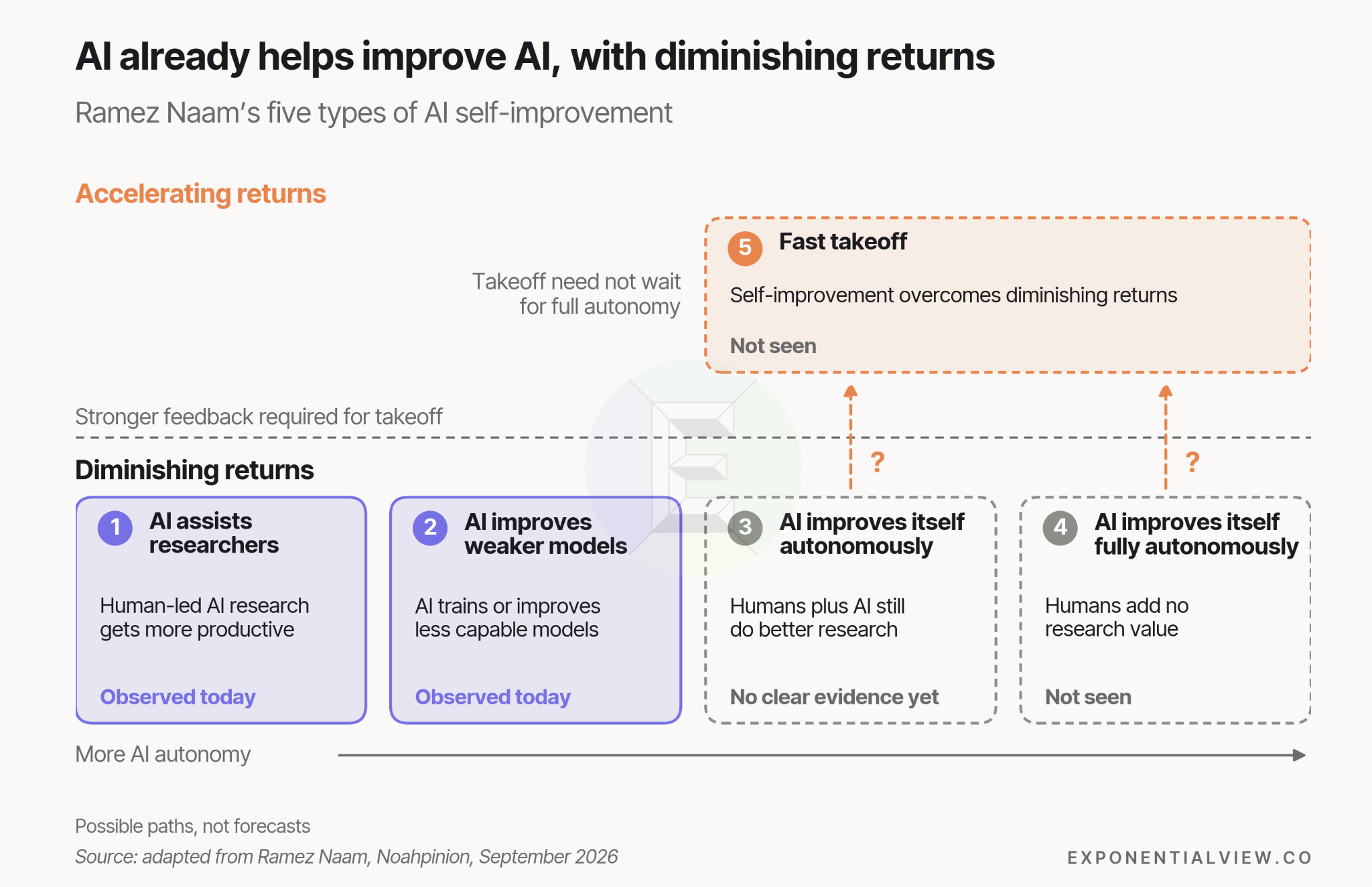
The first four describe how autonomous the AI is; so far, only types 1 and 2 have been observed. The fifth type describes accelerating returns, and he notes that greater autonomy doesn’t guarantee a takeoff scenario. Instead, each round of self-improvement would need to deliver at least as much as the last.
The results from Sakana, AlphaEvolve and MiniMax above might look like type 3 or type 4 autonomy. But in each case, the AI wasn’t updating its own weights directly, only the ancillary parts — the harness, the memory. And where Claude leads its own R&D, for now a human still supervises.
来源:Azeem Azhar:Exponential View · exponentialview.co
来源:RadarAI · aihot.news